
A fart. It started with a goddamn fart—a fart that smelled of rotting waste baking at the peak of a drought-dusty summer, shoving its invisible fist down my throat and trying to yank out my stomach—over, and over, and over again. I never would have guessed that one pop of air could be a not-so-regal horseback messenger making its dramatic entrance to alert me that something unknown and potentially urgent was coming.
Most women have a certain aunt that visits them each month. My aunt has always been like much of the rest of my family—a sporadic, unannounced, moody visitor who shows up and won’t tell you how long she’s going to stay but makes you dream of her departure every miserable moment she’s with you. Thus, my aunt’s absence of several months was nothing I paid attention to, and my girl parts appreciated the extended time away from her.
I probably should have seen it coming when a gentle breeze felt like nails hammering into my boobs—even with my super-padded bras. Food? I couldn’t get enough of it. I bought sale items at the grocery store, pocketed the savings, used the cash to buy myself treats, and ate them in places where I thought I was alone. The behavior was out of the ordinary even for this big girl, but I still didn’t see what was going on—until that fart.
Mark farted all the time. Normally they were mostly noise, with an occasionally bothersome scent, but nothing toxic. This fart was different. It took several minutes for my nose, throat, and stomach to recover from the trauma. I chalked it up to the rogue exhaust of cheap human fuel—until the next morning when I realized that the fart was just one of the warriors wreaking havoc on my body. The ringleader of the attacks was a little blob that was multiplying in size each day.
It was cancer. I had no idea what kind, but dammit, I knew it was cancer, and I knew I needed to get help. Since the first thing a doctor asks any woman between the ages of 10 and 80 is if she might be pregnant, I figured I’d get that out of the way. I’d go to Planned Parenthood, pee in their cheap little cup with my name sloppily scrawled on a white label, and then go straight to my regular doctor and say, “I know I’m not pregnant, now cure my cancer.” I got as far as the cup.
“Congratulations, you’re pregnant.”
My frozen face looked at the woman before I snottily asked, “What?”
“You’re pregnant,” the plain-looking, pleasant-speaking woman said.
“No.” I said sternly, “I have cancer.”
“You’ve been diagnosed with cancer?”
“No. That’s why I’m here. To rule out pregnancy so my doctors will test me for cancer. It’s probably cervical or ovarian.”
“No. It’s a baby,” she smirked fighting her laughter.
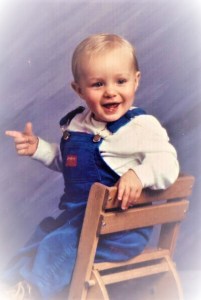
My head felt like it was vibrating with the buzzing in my brain. I must have heard it wrong. What words rhyme with baby? Maybe? Rabie? I had rabies? No, Planned Parenthood wouldn’t be able to test for that, but I could not be pregnant. My periods were never regular. I probably couldn’t have kids, and it had be a mistake. It had to be cancer.
“You’ll need to make an appointment with your doctor to find out how far along you are and start prenatal care,” Plain Jane added.
“Okay,” I said, still trying to decipher what that word meant. Pregnant? Not me. This was not part of my plan. I was never going to have kids. I was going to let my wanderlust and spontaneity forever lead me. I had no idea that one brief visit to Planned Parenthood would change my life. I wasn’t prepared for all that would come along with my little blob or the never-ending questions that would bombard me for the rest of my life.
It took a while for me to get used to the idea that the growth inside of me was not cancer but a baby, a miniature human. It was something that, in 26 years, would be as old as I was that day—something that I would be completely responsible to care for and one day turn loose on the world. It was a commitment, a huge commitment. Commitment. That word still scares the hell out of me. The longest commitment I ever made was going to school, and that was only because I had to go, and I even sucked at that. I probably spent more time in detention for missing school than I actually spent in class. I was spontaneous, hotheaded, and a risk-taker. If I chose to have this kid, did I really have to send him to school? Couldn’t I keep him home with me to go on wild adventures? What the hell did it mean to be a mother anyway?
I thought about my own childhood and my own mother. I decided that the best way to tackle this would be to make sure I did everything for my child that my mother failed to do for me. I would be everything to my child that my own mother was not. I would repeat all the wonderful things that other mothers, the many women of various ages, belief systems, races, and cultures had been for me. I would even try to repeat those rare moments my mother made me feel loved, safe, and secure. But no matter what, I was going to be a different kind of mother to my little blob than my mother was to me.
It happened during a soak in the tub, as I slide down to immerse as much of my body underwater as I could. It was the delicate dance of butterflies bouncing in my stomach as if they were searching for a flower to land on. It took a second for me to realize that it wasn’t sweat rolling down my face, but tears. I realized it was the baby, my baby. He was real, I mean really real. He wasn’t just a blob invading my body, making me swell, fat (or fatter), or act like a lunatic. No, he was real, and he was wiggling his little arms and legs around to let me know that he loved the water. At that time, I had no idea that the baby who the doctors said would be an Arian was going to be a Piscean—a water sign. His love of water began before he drew his first breath.
I suddenly understood one piece of my mother. When one of my brothers got in trouble and she had to go to court, she said she was going to beg the judge to let him go. I told her, “He’s a screw-up. Let him rot there. He deserves it.” She tried to explain to me that she couldn’t, because as much of a pain in the ass as my brother was, he was still her…baby. I think at that time I called her stupid or something equally eloquent. But in the bathtub, I remembered that conversation, and I suddenly understood what my mother meant. I hadn’t even touched my baby, but I knew that the love I felt for what was inside of my belly was like no love I’d ever felt. All those guys in the past whom I swore I loved and couldn’t live without? It was as if they never existed compared to what I felt at that fluttery moment. Even my son’s father, whom I loved, wouldn’t have been my first pick if forced to choose. That steamy, teary, bathtub moment between my baby and me changed everything. My body was no longer mine. It was a fortress to protect something priceless and more precious than my own life. The food I ate would no longer be what I wanted. Instead, it was a bountiful garden providing sustenance to my magical little mischief-maker so he could grow strong enough to survive the exhausting journey of leaving the warmth of his mama’s belly. My life and the risks that were fun to take no longer had appeal. Nothing was about me anymore. I was no longer the star of the Angela Show, and I didn’t mind stepping off the stage for my new, behind-the-scenes job, despite my overwhelming fear that I might fuck up such an important assignment.
Being a mother has brought the greatest extremes in my life: the feeling of being eviscerated when I thought someone had stolen him from me, and how when I found him, my deep sigh of relief as life entering me again. The tears—enough to fill another bathtub—for all his owies I couldn’t bandage, for all the moments I questioned myself, and all the times I felt him pulling away and wondered if I had become my mother or if it was him becoming his own person. The warmth that fills me when I see glimpses of the innocent, compassionate, empathetic little boy surfacing in the 20-year-old man who I still call my baby. My feeling of pride and accomplishment when I look into his blue-green eyes and see the young man so many people love. The huge emptiness I feel since I had to push him out of the nest so he could learn how to fly.
It all makes me wonder what it means to be a mother. Is motherhood such intense contradictions for every woman who has children? Will the late-night worry that he’s okay ever leave? Did my own mother feel these same things? Do the same questions bombard her? I contribute my son’s presence with saving my life. He gave me purpose. His birth completed me and made my life matter. At times I wonder if I’ve succeeded at being a mother—the job the heavens gave to me. I want to say that I did the best that I could, because when my little baby blob arrived, he didn’t have an instruction manual with him. I had to wing it. Knowing that, it makes me want to give my mom the same credit, but I have so many questions that I know she’d never answer, and I get angry, so instead, I try to forget her and think about my baby and try to be someone he believes fits the definition of mother.
 Phoebe Lulu
Hi Phoebe, no, you never stop worrying. My son is almost thirty and is a wonderfully talented writer and decent man, but there are times I remember when he was just a helpless little baby whom I could protect. It is very hard to see him on his own-I think we moms will always feel those contradictions. Your blog is beautifully written.
LikeLike
Thank you, jennygracespoetryandcreativewritingtechniques. I think you are correct. I tell friends with younger kids that being a mom sometimes feels like a near-impossible balancing act. You have to give them enough space and freedom to learn to be independent and confident, but you need to be close enough and patient enough so that they always know that mama always loves them.
LikeLiked by 1 person